The Adventure Continues ...
Our adventures in blogging continue....
Watch for new blogs going live February 5, 2007 ...
- Applied Math 40S (Winter '07) (Grade 12)
- Pre-Cal 40S (Winter '07) (Grade 12)
- AP Calculus AB continues ... (Grade 12)
Our adventures in blogging continue....
Watch for new blogs going live February 5, 2007 ...
- Applied Math 40S (Winter '07) (Grade 12)
- Pre-Cal 40S (Winter '07) (Grade 12)
- AP Calculus AB continues ... (Grade 12)

And so we begin where we left off ... don't let the sky be your limit. ;-)
I'm so glad we've had this time together,
Just to have a laugh or learn some math,
Seems we've just got started and before you know it,
Comes the time we have to say, "So Long!"
So long everybody! Watch this space for pointers to new blogs for each of my classes.
Farewell, Auf Wiedersehen, Adieu, and all those good bye things. ;-)

Last Thursday morning the students in this class wrote their final exam. That afternoon we wrapped up our class and recorded this podcast. It's called a podcapsule because, like a time capsule, it'll stay here as a permanent record of the students reflections and recommendations to themselves on how to guarantee their success in their next math class.
Although the class is over and the podcast is done you can keep it going as long as you like ...
First listen to the podcast (6.3 Mb, 13 minutes 11 seconds), then, if you like, you can keep it alive by adding an audio comment or text comment on this post.
1 comments
 Labels:
podcast
Labels:
podcast


Solution:
6C4 . 5C3
= 150

 There are 60 different trails
0
comments
Labels:
scribe post
Hello guys!!!!!
Our topics in mathematics just ended. For us it is a relief but we must always put in mind that learning in a never ending process so there are still maths stuffs out there waiting for us. Anyway, this morning we did a rehearsal examination in probability. Mr. K gave us 30 minutes to work on it then after that we had a group discussion where we talked about our answers and did some brainstorming. Afterwards, Mr. K discussed with to us the right answers with their respective solutions. The questions given are:
(1) A certain soccer player has scored on 82% of his penalty kicks throughout his career. Given this information, the probabality that he will score on exactly 4 of his next 5 penalty kicks, correct to the nearest hundredth, is
(a) 0.80
(b) 0.66
(c) 0.41
(d) 0.08
The answer is (c) 0.41 because the solution for this problem is .bmp)
(2) If P(A) = 3/4 and P(A and B)= 1/2, where A and B are dependant events, then P(BA) equals:
(a) 1/4
(b) 3/8
(c) 2/3
(d) 5/4
The answer is (c) 2/3. The problem indicated that A and B occured in dependant events, which means that both have to happen.
Solution:
P(A) * P(B) = 1/2
3/4 * P(B) = 1/2
P(B) = 1/2 * 4/3
P(B) = 2/3
(3) Peter places 5 equal-sized tiles in a cloth bag. Each tile has a letter on it. The letters are P, E, T, E and R. The probability that Peter selects the 5 tiles, one at a time, in order such that they spell PETER, correct to the nearest hundredth, is
The answer is 0.02.
>
.bmp)
(4) A child 2 quarters, 2 dimes, and 3 nickels in his pocket, but he does not understand the value of any of the coins. He puts 35cents worth of candy on the counter at a store and randomly selects two coins from his pocket. The probability that the two coins he selects will have a total at least as high as the value of the candy is:
(5) It is known that 53% of graduating are boys. Three are chosen at random. Given that at least two of the three grads are boys, determine the probability that all three of the grads are boys. ( Answer accurate to at least 4 decimal places. )

0
comments
Labels:
probability,
scribe post
Here are the notes to add to your math dictionaries for this last unit on Sequences and Series. The notes must be copied into your dictionaries by hand.
Here they are: Page 1 of 3, Page 2 of 3, Page 3 of 3.
0
comments
Labels:
Sequences
 sorry e, i didn't notice it was doing that..but here you go just click these links.
3
comments
Labels:
scribe post,
Sequences
the next scribe is JHO-ANN.
a) what is the sum of the integers from 1 to 5000?
T1 = 1
D = 1
N = 5000
‘the initial term is 1
‘the to from getting from 1 to 5000 is 1. on account that each term increases by one. And that it doesn’t say what the difference really is so its 1
‘n is the rank of the rank of the term we want to find. The rank is the sum in this case and we want to find what the sum is when the sequence reaches 5000.
Sn = n/2[2(t1) + (n – 1)d]
S5000 = (5000/2)[2(1) + (5000 – 1)1]
S5000 = 2500[2 + 4999]
S5000 = 2500 = [5001]
S5000 = 12 502 500
b) what is the sum of all multiple of 7 between 1 & 5000?
T1 = 7
D = 7
N = 714
Since it says multiples of 7,the initial term is 7 because you start with 7 when it comes to “multiples of 7”. The difference is 7 because it increases by 7 each time.
Now we want to find the sum of sequence when it reaches to 5000. but we don’t really want to find 5000. since we’re looking for the sum of the multiples 7 between 7 & 5000 then there really aren’t 5000 terms if we’re increasing by 7 each time. To find what the rank is, we need to 5000/7. and you get 714. whatever. Don’t need to worry about the decimal answers if I were you.
Sn = n/2[2(t1) + (n – 1)d]
S714 = (714/2)[2(7) + (714 – 1)7]
S714 = 357[(14 + 7130)]
S714 = 1 784 785
c) What is the sum of all integers from 1 to 5000 inclusive that are not multiple of 7?
12 502 500 – 1 786 785
= 10 715 715
This is a no brainer but I’ll explain it to you anyways. To get the answer you take the sum of all integers from 1 to 5000 and subtracted by the sum of the multiples of 7.
A super ball is dropped from a height of 200 cm. It rebounds to ¾ of the distance it fell each time it hits the ground. What is the total vertical distance traveled by the ball when it hits the ground for the fourth time?
We know that each time it hits the ground,the ball comes back ¾ of the last distance it traveled. So it traveled down, up, down, up, down, up, and down. So in order to calculate the total distance it traveled. We need to brake this into 2 solutions first. We need to solve the “down” distance and then the “up” distance and then add the together.
Down:
So what are the sequences?
Well since the first term is 200 and it decreases every time by a ¼( bounces back to ¾ of the last term) and that it hits the ground for times…..
200 + 150 + 112.5 + 84.375
(but we really didn’t need to know that only the first term)
*DID YOU KNOW: that all the things we need to know to solve the question was in the question itself? Go check it out ; - )
T1 = 200
R = ¾
N = 4
S4 = 200(1 – (3/4)4)/(1 – ¾)
S4 = 546.875
(thanks to the help of our righteous hero- the CALCULATOR!!)
The 3 term for the “down” distance is:
‘think everything opposite of what I said from the other part
150 + 112.5 + 84.375
T1 = 150
R = ¾
N = 3
S3 = 150( 1 – (3/4)3)/ (1 - ¾)
S3 = 346.875
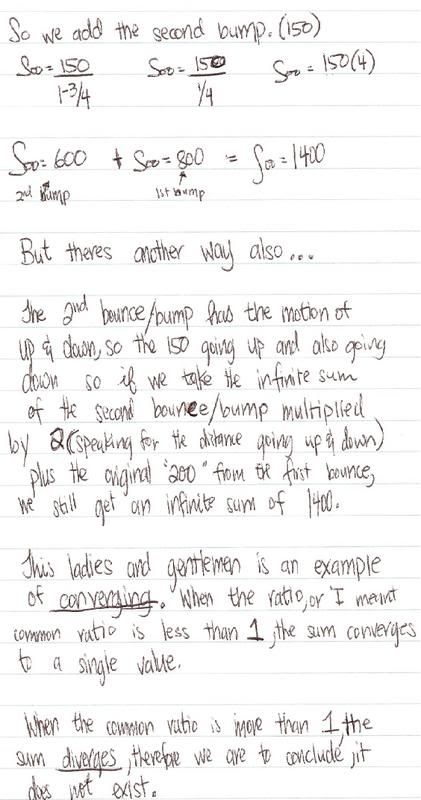
Now we add the two answer to get …….
546.875 + 346.875 = 893.75 (anybody else noticed that the is a difference of 200 for the 2 answers. Me thinks there is a shortcut for this problem….)
……………TAAADAAAAA!!
I've voice recorded mr k's lecture today. It covered about half the class. Now i have listened to it a bit and you have to crank up the volume super high to listen on account that the mic was far from mr k. I just wanted to test out if it worked or not. Feel free to add some comments about it. Apologies to the loud scratching sounds on account i was moving the mp3 play on the desk, i assumed that it picked up the sound.
test voice lecture
1 comments
Labels:
scribe post,
Sequences
This is RICHARD and I'm your scribe for today.
Before we started our lesson in Geometric sequences, Mr. K discussed the solutions on the on-line quiz on probability.
(1) A card is drawn randomly from a deck of 52 playing cards. What is the probability that it will be a spade or a face card?
(3) A certain partial deck of cards contains 6 red cards and 4 black cards. Two cards are chosen at random. What is the probability that both cards are black?
R = 6
B = 4
4C2
____ = 6/45
10C2
(6) The diagram shows a partial map of a certain city park, with walking paths located on the grid lines. A tourist starts at point A and randomly selects a path to point C, walking only to the south and east. What is the probability the tourist passes through point B?
The number of ways to get to point C is RRRDD which is 5!/3!2!. The number of ways to get to point B is RRD which is 3!/2!. The number of ways to get to point B over the number of ways to get to point C is 3/10
(7) It is known that about 5% of coffee cups used in a particular restaurant will be chipped. What is the probability that out of 10 cups selected at random, exactly 2 will be chipped?
CNCNNNNNNN
C - represents the chipped
N- represents not chipped
10!/8!2! (o.o5)² (0.95)^8
= 0.0746
(8) Three coins are tossed. What is the probability that at least two heads turn up?
These are the possibilities that you can get at least two heads
HHT = 1/8
HTH = 1/8
THH = 1/8
HHH = 1/8
The sum of these events is 1/2
(10) A jar contains 5 red and 7 blue marbles. What is the probability of pulling out 2 blue marbles in a row, without replacement?

(2) A certain kind of die has four sides, labelled 1 to 4. When the die is rolled, each side has a probability of 1/4 that it will appear on the bottom. If the die is rolled 5 times, what is the probability that the side labelled “3" appears on the bottom in exactly two of the five rolls?
3N3NN
= 5!/ 2!3! (1/4)² (3/4)³
(4) Over the course of his basketball career, Julius succeeded in making a free throw in 75% of his attempts. In a randomly selected game, he attempted to make a free throw 12 times. What is the probability that he succeeded in 8 of the 12 attempts? (You don't need to know anything about basketball to answer this problem.)
12C8 (0.75)^8 (0.25)^4
(5) Three different names are randomly selected from the following list of five names. Max, Kim, Codie, Lee and, Alex. Determine the probability that “Kim” is one of the three names selected.
(1· 4C2)/ 5C3
= 3/10
(9) Assuming equally likely probabilities for male and female births, what is the probability that a four-child family will have at least one boy?
P(all girls) = (1/2)^4 = 1/16
P( at least 1 boy) = 1 - 1/16 = 15/16
After we had discussed about the on-line quiz, we proceed to our topic in Geometric sequences.
A mathematician named Carl Friedrich Gauss is a brilliant student. One day his teacher got angry because the class is so noisy. She gave an activity to keep them busy. She asked them to add the numbers from 1 to 100. Gauss came out with a better solution. He instantly computed the answer 5050.
t1, t1 + d, t1 + 2d, t1 + 3d, . . . . . . t1 +97d , t1 + 98d, t1 + 99d

Find the sum of the arithmetic sequence 2, 7, 12 17, . . . . S 51
S51 = 51/2 [2(2) + (51-1) 5 ]
= 51/2 [ 4 + 250 ]
=51/2 (254)
= 6477

given the geometric sequence 16, 8, 4, 2, . . . .Find the sum of this sequence up to th 10th term.
r = 1/2
t1 = 16
 that's it for today!! the next scribe will be Jefferson..
I can't believe I totally forgot about this! Anyways Probability is alright. There are some questions that I find I'm able to do fast and other questions where I really have to think about it and I get stuck because I can't find the compliment. I actually think probablitity is a lot easier than combinations because probability uses combinations so I'm a lot more familiar with it. But overall I understand how to get some of the questions. But questions like the one on the pre-test I still need to work on. I'm just glad I made it on time to do the BoB. 2 minutes before math starts haha.... Do well guys (:
0
comments
Labels:
Blogging On Blogging.
One thing I can say about probability is that you need to understand the situation to get the right solution...
we follow some basic rules such as if it is "and" it means that we multiply probabilities and if it says "or", we add probabilities. But we also need to know if it is mutually exlcusive or not, independent or dependent...
...but there's only one thing that we shoulld always keep in mind regarding the probabilities, it is a number between 0 and 1 and the sum of the probabilities of the events will always equal to 1...
I hope everyone will do good on the test..Good luck and God Bless!!
0
comments
Labels:
Blogging On Blogging.
WEEEEEEELLLLLLLLLLLLL, This sort of hard to explain on my part. In probability it's easy to understand after the teacher explains it to you. But when you apply it, It's all a puzzle, and i hate puzzles! I know how to do probability questions that involve the word "given that", but I'm just a little confused with the independent and dependent and mutually exclusive and not mutually exclusive. I mean what do you do after you find that out? what sort of math is involved if these events are mutually exclusive. I have the hardest time understanding it. They rest of probability is A-OK for me! the tree diagram always helps and it gives you more than you're looking for if you know what I mean.
0
comments
Labels:
Blogging On Blogging
What was the probability that after taking the day off school to sleep so that maybe i'd get my voice back, that i would remember to do my blogging on blogging?? all i can say is Thanks to the kids that posted them before now, cause when i went to check the scribe post to see what i missed, BOBs were posted!! Anywho enough about that, how about that probability unit?? I don't know about any of you, but I thought it was a good unit... I think there were only a couple times that i didn't know what i was doing, and those times were cleared up rather quickly. The other day when we did the pretest my group did so well.... minus a slip up where we were soo close. My favourite thing about the unit was doing the "what is the probability of A given that you already B?" those ones were no sweat... but the combinatoric ones still trip me up every once in a while... especially when i get distracted :D ... so i hope that i can keep focused and do well on that test tomorrow... and of course that everyone else does well too.... ok that's all for me tonight cause i'm getting some more sleep... who knows i might even get my whole voice back tomorrow.... till then, like mr. k says "Learn hard!!"
0
comments
Labels:
Blogging On Blogging
This unit had it's pros and cons. In the beggining i was getting confused, but since we were exposed to this unit for quite some time i was able to understand the concept, and therefore i am confident i will do well in this test. Hmmm maybe..haahha can't be too confident..but that pre-test was good, i was able to answer most of the questions without a problem. Hopefully i will do well tomorrow. Man i have been missing a lot of work lately, because of my loss of internet connection, got to earn some marks. GOOD LUCK everybody =D
0
comments
Labels:
Blogging On Blogging.
wow this unit has it's up and down. You would have to read twice ,to be able to write down your answer. sometime the answer you think its right might be even wrong.The first couple of part of unit was easy but it gets harder ,and harder. These questions you would have to do alot to be able to be familar with it. So practice,practice. Well thats all i have to say. bye
In probability well I'm not so good at it and let's just leave it at that. On plenty of questions I end up making plenty of mistakes, whether it's to using the incorrect method or leaving something out when solving the problem. While practice does help improve something, I've had close to a decade of problem solving questions and I doubt another few days is going to get me ready for those questions.
0
comments
Labels:
Blogging On Blogging
Hey everyone its Tennyson ,well today we just did some questions but i was unable to finish. i will just put down the one that we did only.The next scriber can carry out the other questions.
1). List the 1st four terms in each sequence
a).tn= 3(n-1)
b).tn=(n-1)2
c).tn=2(power of)n-1
a).tn= 3(n-1)
0
comments
Labels:
probability,
scribe post
I don't really know where I am right now in the probability unit....T_T.. I get some of the answers sometimes correct and sometimes I get some of the answers wrong and sometimes I know I have the correct answer and got it wrong.....sometimes I have the right answer but get the part where you solve for the correct answer wrong............. I guess I just need a Little more practice!
good luck tomorrow~
0
comments
Labels:
Blogging On Blogging
Well now, I sorta like probability, but the part I didn't or well, I wasn't fond of much was, the part where combinatorix was combiend with probability, only because I don't think I did that good during combinatorix, which I need to review on. I guess it is kinda neat though how they're together like that. Overall I did like this probability unit, I hope I have as much luck tomorrow during the test though! I wish everyone luck on that, okay bye bye.
0
comments
Labels:
Blogging On Blogging
Probability for me is one of the scariest topics in mathematics. I found it hard to solve questions about cards and its decks. Moreover, thinking for the starting solution such as the tree diagram is another burden for me because I cannot really imagine things to be fitted in the diagram. On the contrary, I found it a little challenging. Some of the questions are really tough but sometimes I managed to solve it. Another is I want to acknowledge the effort that Mr. K gave to us in order to understand the probability well because he explained everything in details and still willing to explain it more if some of us was not able to understand it.
Honestly saying I'm not doing my assignments in probability. It is the reason why I cannot push myself in to a higher level when it comes to probability.
GOOD LUCK!!!!!!!!!!!!!
God bless us all in the upcoming test!!!!!!!!
0
comments
Labels:
Blogging On Blogging
I think that this unit was interesting, and I enjoyed doing it. I like making the trees for the problems which make everything easier and more organized. I just have to remember the methods to be used for certain problems. Using some of the Counting Principles helps a lot in some of the problems, and makes it easier to calculate too, so I'm glad we get to use some of that. Hopefully I won't forget to use some of the rules in the problems, but I'll probably just look at some of the problems we did in class so I would probably know which one I would need to use for the ones that will be on the test. The pre-test was a little hard, but I think I'm prepared for the unit test. Everyone Good Luck!!
This unit is very interesting and I get most of it. It's just that sometimes when it seems like you have the right answer, you don't..does that make any sense? What I mean by that is that a wrong answer can seem right as to the point where it looks possible so you end up getting the wrong answer. So multiple choice questions for this unit are pretty difficult. I really like the long answers where something is assumed given that an event happens, because they're a breeze. What's really hard to remember is that you always have to have the probability over the sample space and I always forget that. The pre-test was okay so I'm sure the test will be okay as well. Good luck everyone.

Here is it! You have until midnight tomorrow to complete it. We'll talk about in class on Wednesday morning. The test is Wednesday afternoon.
Learn Hard!
Wouldn't it be nice if the world really worked like this ... ;-)
0
comments
Labels:
probability,
Quiz
today we started off with mr. k giving us questions on the board.
find the next three numbers..
1, 2, 4, 8, 16, 32
how you would get the next set of numbers was multiplying the number by two
OR 1, 2, 4, 7, 11, 16
how you would get this one was to find the pattern in the sequence. so you would have to find the difference between the numbers. for example: 2 and 1, the difference is 1. and the difference between 4 and 2 is 2. so you would get the pattern. you know that the number is increasing sequentially. so the next number must be a 7 - since the next number is a 7, the difference between 7 and 4 is three. and so on..
6, 11, 16, 21, 26, 31
for this one, the difference between the numbers is 5 and it's always constant.
3, 6, 12, 24, 48, 96
this one is basically like the first one, you multiply the numbers by two.
1, 1, 2, 3, 5, 8, 13, 21
for this one.. you find a pattern by adding the numbers.. for instance: 1 plus 1 is 2. then 2 plus 3 is 5. and 3 plus 5 is 8. so you get the point..
1, 3, 6, 10, 15, 21, 28
this one is basically like the first one.. but the second answer.. but this one doesn't start at 1. it starts at two - meaning.. the difference between 3 and 1 is 2. 6 and 3 is 3. and it's going up sequentially, and so on..
x, -x2, x3, -x4, x5, -x6, x7
for this one, you would multiply by -(-x)
3, 4, 7, 11, 18, 29, 47
this one, you add the numbers together. 3 and 4 is 7. 4 and 7 is 11. 7 and 11 is 18. etc etc..
77, 49, 36, 18, 8, 8, 8
this one was kinda tricky. you would split the numbers - so you would get 7 and 7. you would then multiply them together and you would get 49. 4 times 9 is 36. 3 times 6 is 18, and soo on..
in the afternoon class, we had a pretest on probability. and here are the questions and solutions to them.
1. twelve people, including you, are members of a choir. the choir director is going to choose three members to attend a workshop. the probability you and two other members will be chosen is:
a) 1/4 b) 3/10 c) 1/12 d) 1/10
first of all, YOU have to go. so you would get 1 x 11C2 because you're part of that twelve so there are eleven people remaining to choose from - and you're going to choose two. and the denominator would be 12C3 since there are twelve people and you have to choose three. so that would look like..
1 x 11C2 ALL OVER 12C3
and that would all work out to 1/4, which would be a.
2. rex is playing a guessing game. the probability he will guess each question correct is 0.3. what is the probability he will guess exactly 5 out of 10 questions correctly?
a) 0.15 b) 0.10 c) 0.29 d) 0.80
so the P(correct)= 0.3 and the P(wrong)= 0.7
since there can be different ways of getting the questions wrong or right, but you still have to get five correct. so you would get..
10!/5!5!
the 5! represents the correct ones and the other 5! represents the wrong ones. you would then get..(C)5(W)5
(0.3)5(0.7)5
and when you work that all out, you would get 0.10 and that's the answer b.
3. you choose four digits from the numbers 0-9 (ten digits in total), with no repeated digits. to win a prize, all four of your numbers need to math the four selected by a computer. the probability that you will win a prize is:
P(all four digits)= 4C4 ALL OVER 10C4
and when you work that all out, you would get 1/210 (and that's the answer)
4. the serial nuber of a $10 bill contains 8 digits. if your $10 bill contains the digit 7 at least once, you will win a prize. what is the probability that your $10 bill will win?
first find the probability that you wouldn't get any 7's. so, the probability that you would get a 7 is 1/10 and the probability that you wouldn't get a 7 is 9/10. soo..
P(not seven)= (0.9)8
since you now have the probability of not getting any 7's, you can now get the probability of getting at least one 7.
P(7 at least once)= 1-(0.9)8
so, you would get 0.57 (and that's your answer)
5. jeff takes a lunch to school on two days, and on the other three days he buys it. if he takes lunch - he is late for his period 4 class 15% of the time, but if he buys lunch - he is late 35% of the time.
a) what is the probability that jeff arrives on time?
b( if jeff was late, what is the probability that he took his lunch to school?
first make a tree diagram
P(arrives ontime)= P(takes&ontime) + P(buys&ontime)
= (0.4)(0.85) + (0.6)(0.65)
= 0.34 + 0.39
=0.73
= 73%
P(late|took)= P(takes&late)/P(takes&late) + P(buys&late)
= 0.06/0.06 + 0.21
= 0.06/0.27
= 0.2222
= 22%
oh yeah, the test is now on wednesday.
umm.. the next scriber is tennyson.
gooday&goodnight (:
0
comments
Labels:
scribe post

It's a new year with new units, new tests, and new learning. And how will you meet those challenges?!



9
comments
Labels:
scribe post
Okay, today Mr.K started and finished off, with the following questions:
1)Tickets numbered 3,6,9,12,15 and 18 are placed in Box A. Tickets numbered 6,12,18,24 and 30 are placed in Box B. A ticked is chosen at random from each box. Find the probability:
a)That both tickets have the same number?
First find the numbers that are in both Box A and Box B. You will see that only 6,12, and 18 are in both Box A and Box B. Then calculate the probability for each, as shown:
P(A6B6)=(1/6)(1/5)= (1/30)
P(A12B12)= (1/30)
P(A18B18)= (1/30)
Now add them up:
(1/30)+(1/30)+(1/30)= (3/30)= (1/10)
Therefore the probability that both numbers are the same is (1/10).
b) That there are different numbers on the two tickets?
This question is simple to answer, because we have just figured out how many times the numbers will be the same and it was (1/10), so now all we have to do is subtract this fraction from 1, resulting in the probability of the numbers not being the same.
1-(1/10)= (9/10)
2)John uses Google 50% of the time, Lycos 30% of the time and Altavista 20%.If he is using Google, there is a 40% chance he is searching for info about cell phones. If he's using Lycos or Altavista the probability he is researching cell phones is 30%.
First we should create a tree to organise our information, and making the question more easier to calculate. SORRY BUT MY PICTURE WILL NOT LOAD AT THE MOMENT, I will quickly look into it and post it as soon as possible.
a)What is the Probability that John decides for info about cell phones?
This will be simple we just need to look at our tree (which i currently don't have up so the change to this question will be made once i clear up my problem.)
b)You see John looking at a website that is not about cell phones. What is the probability he used Google to find it?
P(G/NCP)= (P(GNCP))/(P(GNCP)+ P(LNCP)+P(ANCP)
=(30/100)/((30/100)+(21/100)+(14/100))
=(30/100)/(65/100)
=(30/100)X(100/65)
=(3000/6500)
=(3/65)
=4.6%
Therefore the probability he used Google is 4.6%
*P(G/NCP) meaning: prob. used Google but not for cell phones.
*P(GNCP) meaning: prob. used Google not for cell phones.
*P(LNCP) meaning: prob. used Lycos not for cell phones.
*P(ANCP) meaning: prob. not used Altavista.
3)The letters AADKRRV are written on separate pieces of paper and placed in a bag. If they are drawn from the bag at random, what is the probability that the order of the letters spell AARDVARK?
There where many ways to calculate this problem. I will show you how I have completed the question.
First I reflected on the unit on Counting, and the question became simple. A method we where tought involved lines and multiplying the factorials that go in them. Then I applied it to my knowledge of going about solving probability questions. I came up with this:
3!/8 chances of A 1st.
2!/7 chances of A 2nd.
1!/6 chances of R 3rd.
1!/5 chances of D 4th.
1!/4 chances of V 5th.
1!/3 chances of A 6th.
1!/2 chances of R 7th.
1!/2 chances of K 8th.
Then I simplified the answer and this is what I got:
(3!2!)/(8!)
4)Two traffic lights operate independently. The probability that the first is red is 0.4. The prob. that the second is red is 0.7. What's the probability that neither are red?
P(NR1)= 0.6
P(NR2)= 0.3
(0.6)(0.3)=.18
Unfortunately the Big Space has come back,heh, I was able to kinda fix but its still there.
THE NEXT SCRIBE IS THE JESSICA THAT HAS'NT DONE 3 SCRIBES YET.
0
comments
Labels:
scribe post
First day of class after the winter break and of course not much happened today, as we went through a few questions which are listed below. Other then that we discussed more about probability.
Suppose a test for cancer is 98% accurate. This means that the result of the test is correct 98% of the time. Suppose that 0.5% of the population has cancer. What is the probability that a person who tests positive has cancer? Suppose 1, 000, 000 randomly selected people are tested. There are 4 possibilities.
P(C|P) = 4900/(4900 + 19900)
= 19.76%
0
comments
Labels:
scribe post
Oxford statistician Peter Donnelly explores the common mistakes humans make in interpreting statistics, and the devastating impact these errors can have on the outcome of criminal trials.
You learned the math he's talking about here today.
Click on the picture. (22 min. 6 sec.) 
0
comments
Labels:
probability,
TED Talks
Probability
1st period class
it was the day before the Holiday break so we didn't do much but as usually we started the day by doing question......^_^
Blood types in North America are distributed as follows:
Type O: 44% Type A: 42% Type B: 10% Type AB: 4%
a) are the blood types mutually exclusive?
b)what is the probability that a couple both have type O blood?
answers
a) no (because the blood type can be both be "A" "B" or "AB" and "O" is the universal blood Donner meaning that it can fit into any blood type category)
b) "tree diagram"!! HO = "has blood type "O" NO = No blood type "O"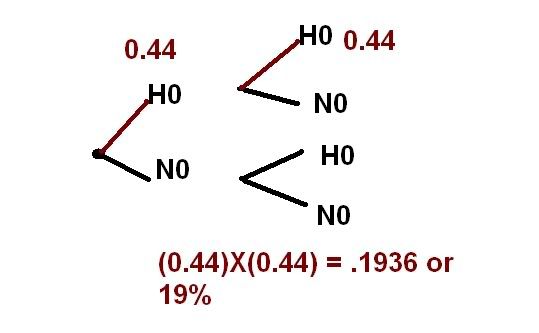
the first tree branch representing one of the couple has 0.44 chance of getting blood type "O" and the second branch representing the second couple has 0.44 chance getting type "O" also. we use "Multiplying Probability" since we want to find out what is the probability that both couples have the same type "O". (HO)HO) = Santa clause? HO NO HO NO I'm just kidding the answer is (0.44)(0.44) = .1936 or 19% that both of them have the same blood type "O".
2nd period class
In a group of 30 students what is is the probability that at least two have the same birthday?
*find the probability that nobody else have the same birthday
* use Pick formula since the order matters
*(# of days in a year)P(# of students) divided by (# of days in a year)^(# of students)
365P30/365^30 = 0.26 then subtract it from 1 ( 1- 0.26 =74%)
therefore the probability of at least two students have the same birthday is 74% (3o students)
and then one of my classmate asked him if our answer for this question was really true....in a 30 people group is there really a 74% chance of picking at least two people that have the same birthday? but most of our classmates are "missing"*wink**wink* so he started getting students on the hall way to make a group of 30 students and then he asked us one by one our birthdays but in our 30 group of students no one has the same birthday so he went back on the hallway to get some more people to raise the chances............were like HO HO HO HO laughing but we forgot to make a list and everyone was like HO NO HO NO no one made a list oi that was fun..............
sorry I couldn't get all the notes for this question :)
T
E
N
N
Y
S
O
N
THE SCRIBE IS TENNYSON .....................FOR MONDAY
0
comments
Labels:
scribe post
Arctic explorer Ben Saunders recounts his harrowing solo journey to the North Pole, complete with gorgeous images, amusing anecdotes and previously unseen video footage from the Pole. At 26, Saunders became the youngest person ever to ski solo to the North Pole, updating his blog daily during the trek. He's now planning the next journey, SOUTH, an unprecedented, roundtrip expedition across Antarctica and back.
His story is spellbinding. There's a really important message for you in the last two minutes ... but you won't really understand it unless you watch the whole thing.
Click on the picture. (18 min. 48 sec.) 
0
comments
Labels:
TED Talks
For the past 20 years, members of the TED community have gathered together to share ideas and passions that are big enough to change the world. Each year they will honor a maximum of three individuals who have shown that they can, in some way, positively impact life on this planet.
Rather than simply receiving financial support, winners of the TED Prize are granted something extraordinary: something which children dream about, but which adults assume is merely the stuff of fairy-tales.
They are granted three WISHES to change the world.
They may wish for anything. And TED will seek to make their wishes come true.
Bono won the TED prize in 2005.
Rock star and activist Bono accepts the 2005 TEDPrize with a riveting talk about our moral obligation (and economic incentive) to help lift Africa out of poverty. He unveils his TEDPrize wishes by challenging the TED community to help build a social movement of more than one million American activists for Africa; to tell people one billion times about the ONE campaign; and to connect every hospital, health clinic, and school in one African country, Ethiopia, to the Internet.
Click on the picture. (28 min. 37 sec.)
For more: Read the update on Bono's wishes.
0
comments
Labels:
TED Talks
Why do people succeed? Richard St. John compacts seven years of research into an unmissable 3-minute slideshow on the real secrets of success (Hint: Passion, persistence, and pushy mothers help).
Click on the picture. (3 min. 40 sec.)
0
comments
Labels:
TED Talks
Photographer Gregory Colbert shares the remarkable images and film footage from his exhibit, "Ashes and Snow," and announces his founding of the Animal Copyright Foundation, which will require that royalties be paid when images of nature are used for commercial purposes.
The pictures are just stunning.
Click on the picture. (18 min. 42 sec.)
0
comments
Labels:
TED Talks
Hans Rowling is a professor of of international health at Sweden's world-renowned Karolinska Institute.
Watch how he displays and talks about statistics. He'll make you laugh and he'll make you think.
Click on the picture. (20 min. 35 sec.)
0
comments
Labels:
TED Talks
You know enough math to get all the jokes in this now ... ;-)
Here is the rubric we've settled on together.
Thanks to everyone who helped put this together. I found this to be a great experience for me as a teacher I hope it was also valuable to you as a student.
Anyway, here it is, version 1.0 fresh out of beta. ;-)
Flickr Assignment Rubric
It is paramount that the picture be in tune with the purpose of the assignment. It should show, first of all, the student's understanding of how the photo is related to mathematics. The hot spots are important too, because that's essentially your way of teaching other people. Creativity is a factor, because keeping one's interest in the photo contributes to the learning process. Finally, the picture quality should be kept in mind too. If we can't see the picture, it's going to be hard achieving all the other requirements.
Tags
The picture must be tagged properly with the course tag and assignment tag. If tags are misspelled or no tags are present the photo cannot be graded and will receive a grade of ZERO. Not tagging your photo properly and accurately is analogous to not handing in your work or not putting your name on it.
| Classification | Mathematical Content (50%) | Hot Spots (35%) | Photograph (15%) |
| Level 4 | Packed with mathematical concepts/facts. (Minimum 7 concepts/facts.) | All hot spots accessible; i.e. "smaller" hot spots are "on top" of larger ones, they do not obscure each other. All hot spots are actually labels and relate to parts of the photo (not on blank space with filled in notes). One or more hot spots include a link to a relevant supporting resource on the internet. Minimum 7 hot spots. | In focus or appropriately focused for effect. The subject of the picture occurs "naturally," it is not a contrived shot. Really makes the viewer "see" math in a place they hadn't realized it existed. (Example: trigonometry) |
| Level 3 | Significant number of concepts/facts included. (Minimum 5 concepts/facts.) | All hot spots accessible. Most hot spots are actually labels and relate to parts of the photo. Not more than one hot spot on blank space. One or more hot spots may include a link to a relevant supporting resource on the internet. Minimum 5 hot spots. | In focus or appropriately focused for effect. The subject of the photo has been "set up" or contrived yet still illustrates math found in "the real world." (Example: derivative) |
| Level 2 | Some effort to include content evident. (Minimum 3 concepts/facts.) | Most hot spots accessible. Most hot spots are actually labels and relate to parts of the photo. More than one hot spot is on "blank" space. May or may not include links to relevant supporting resource on the internet. Minimum 3 hot spots. | In focus or appropriately focused for effect. Although it is a "real world" picture, objects have been used to "draw" the math. An obviously contrived shot. (Example: trigonometry) |
| Level 1 | Very scarce content related to assignment. | Less than three hot spots are visible or have information related to the theme of the assignment. | It is evident that little effort went into finding and shooting a picture that reflects the theme of the assignment. |
| Level 0 | Content unrelated to theme of assignment. | No hot spots or mostly unrelated to the theme of the assignment. | Out of focus and/or otherwise difficult to look at. |
Creativity (up to 5% bonus)
The maximum possible mark for this assignment is 105%. You can earn up to 5% bonus marks for being creative in the way you approach this assignment. This is not a rigidly defined category and is open to interpretation. You can earn this bonus if your work can be described in one or more of these ways:
the 3rd scribe post of ruschev


"green" = students taking math ( 40%-15% = 25% or .25) "brown" = students taking history (35%-15% = 20% or .20) "blue" = students taking both subjects ( 15% or .15) *add up all of our values ( .20+.15+.25 = .60) meaning that there are .40 students that are not taking neither subjects (1-.60 = .40)
Question:
you are dealt a 5 card poker hand, what is the probability that you have "at least one" heart?
Answer:
52 cards in a standard deck of cards and there are 13 hearts * 1 - none leaves all the possibility of "at least one"* *1- none leaves all the possibility of "at least one"* * 1 subtract none leaves all the possibility of "at least one"* * 1 take away all the cards that are not hearts will leave all the cards that are hearts*
39C5 = 39 ( the number of cards that are not hearts) 5 ( 5 card poker hand)
52C5 = 52 (total number of cards) 5 ( 5 card poker hand)
1- 39C5/52C5 = .77
numerator: 39C5 <- 39 cards that are not hearts choosing 5 random cards
denominator: 52C5 <- total cards choosing 5 random cards
"1" <- the highest possible value that you can get ; 100%
0
comments
Labels:
scribe post

Wondering if you're having trouble putting first things first in these last days before winter break?
And
Wanting to wish each of you happiness, peace, and joy during this season! Be safe and enjoy!
Best,
Lani
Looks like its that time again folks... that's right BOB time, which
means a test is really close... and this was a short unit, but that
didn't mean we didn't learn a lot :D ... conics was not my favourite
unit, but it was far from the worst, so overall its not too bad. I
thought i was doing ok...  until i hit the online quiz... but i figure
my barely passing mark was because of some poor
concentration.. i like doing the quizzes at home, but this
time there were just too many distractions, but if i had paid
attention (i just went and reviewed my mistakes... jeeze i made
a lot of dumb ones) i could have done really well... so this means
that during the test i really need to just buckle
down, stay calm and believe that i know what I'm doing... then i will
do just fine... other than that the hardest part for me is just trying
to make everything work out correctly without missing steps because
I'm rushing.. again if i stay calm and take my time I'll end up with
a much better result.. well that's just about it from me, and soon
for conics too (until the going for gold assignment and exam anyways :D )...
So good luck everyone, and I'll see you on test day :D *learn hard!!* :P
0
comments
Labels:
Blogging On Blogging