Showing posts with label Logarithms And Exponents. Show all posts

November 14, 2006

ScubaSteves Scribe Post #2-Review of assignments?!

Well hello there from Cyber-Math World, fellow classmates! This is ScubaSteve reporting for the second time. First off, today was a double class, and we also had a test. But thanks to somebody (not pointing any fingers >_>) we had it on the second class, but I for one, like many knowing alot of us are just dying to get it over with.

Well well, we had a hand out, and some online questions. A handful of people were bravely enough to put up their hand and ask. (I say bravely, I know there would be more, hoping their questions would be answered by a fellow sucke-- err im mean classmate. =]) Well, lets get on it shall we? Of course!. (talking to himself)

This Applies to the Hand-Out we Had. *Questions done below are the ones ask'd*
Our first question that we worked with was #2b
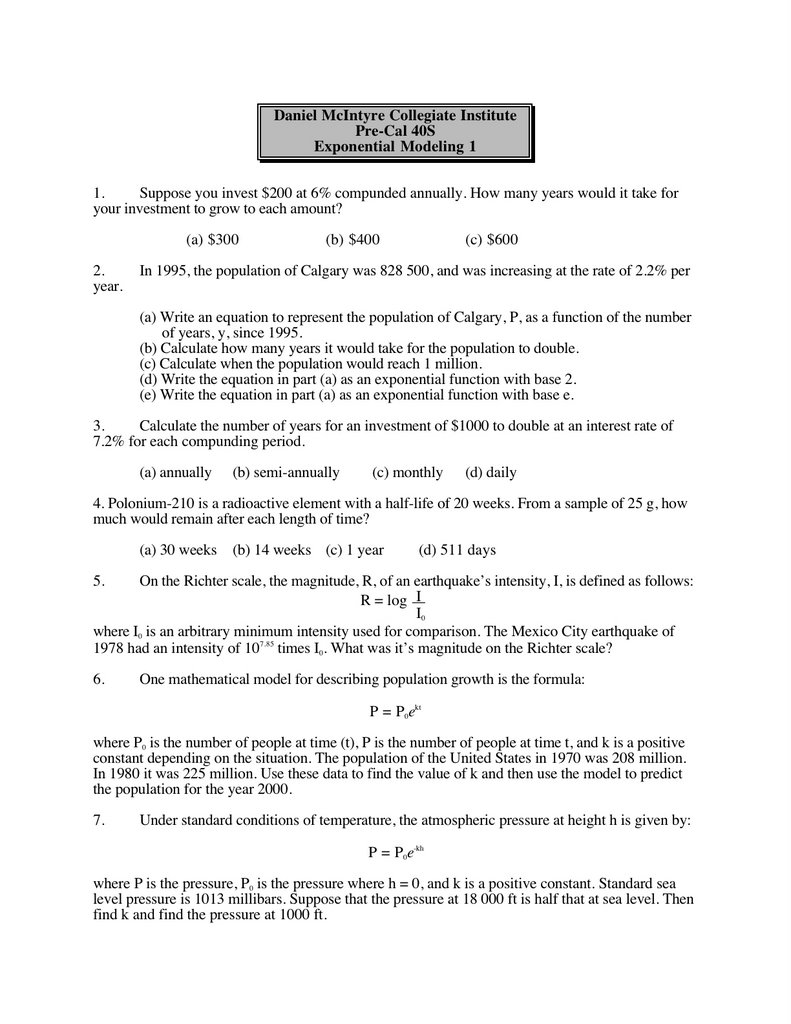
2) In 1995, the population of Calgary was 828,500 and was increasing at the rate of 2.2% per year.

b)Calculate how many years it would take for the population to double.
In terms of real numbers
To begin with, we give ourselves the oh so sexy formula that Mr.K made up to help solve this kind of problem, simple put as:
A=Ao(model)^t
Yes, quite 'hawt' and easy to use. Now lets look at the question(s) and assign the variables with real numbers for us to crunch.
t= 0 in 1995
Ao= 1 (we put 1 because it can be used to describe the "first" amount)
A= 2 (2 is so convenient because it works well with 1, simple because it's twice the amount which we want.)
r= 0.022
Now lets crunch them down in terms of t
A=Ao(model)^t
2=1(1.022)^t (we put in it as 1.022 because we'd want it to increase every year by 102.2%)
ln2=(t)ln1.022 (put them in ln form to bring the t down! >=o)
ln2/ln(1.022)=t
t=31.8520
It will take 31.8520 years for Calgary's population to double.
In terms of e
2=e^0.022(t)
ln2=0.022(t)
ln2/0.022=t
t= 31.5067 (as you can see the two answers are a biiiit off from eachother, but for the record, in terms of e is more favoured than the first one.)
It will take 31.5067 years for Calgary's population to double.

c)Calculate when the population would reach 1 million.
We'll be using the same formula, but change it up a little to relate with the question.
A=Ao(model)^t
1,000,000=828,500(1.022)^t
1.2070=(1.022)^t (divide A by Ao to isloate the model and t, then go in terms of ln)
ln1.2070=(t)ln1.022
t=ln(1.2070)/ln(1.022)
t=8.6455
It will take 8.6455 years for Calgary to have a population of 1 million.

5) On the Richter scale, the magnatude, R, of an earthquake's intensity, I, is defined as follows:
R= log (I/Io)
When Io is an arbitrary minimum intensity used for comparison. The Mexico City earthquake of 1978 had an intensity of 10^7.85 times Io. What was it's magnitude on the Richter scale?
R=log(I/Io)
=>log10^7.85(Io)/(Io) (cancel out the Io's)
=>log10^7.85 (because 'log' is naturally known as log(base10), therefore log(base10) of 10 cancels out and the exponent is brought down therefore...)
=>7.85 on the richter scale.

The following refers to the online assignment sheet Mr.K posted up.

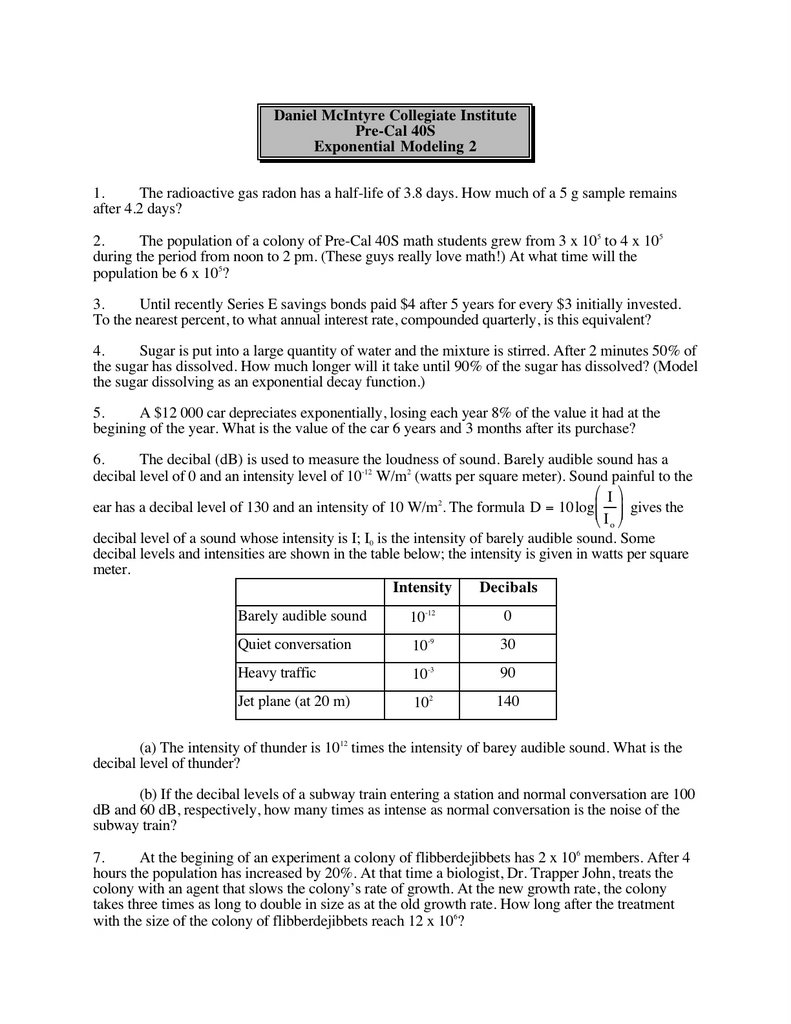
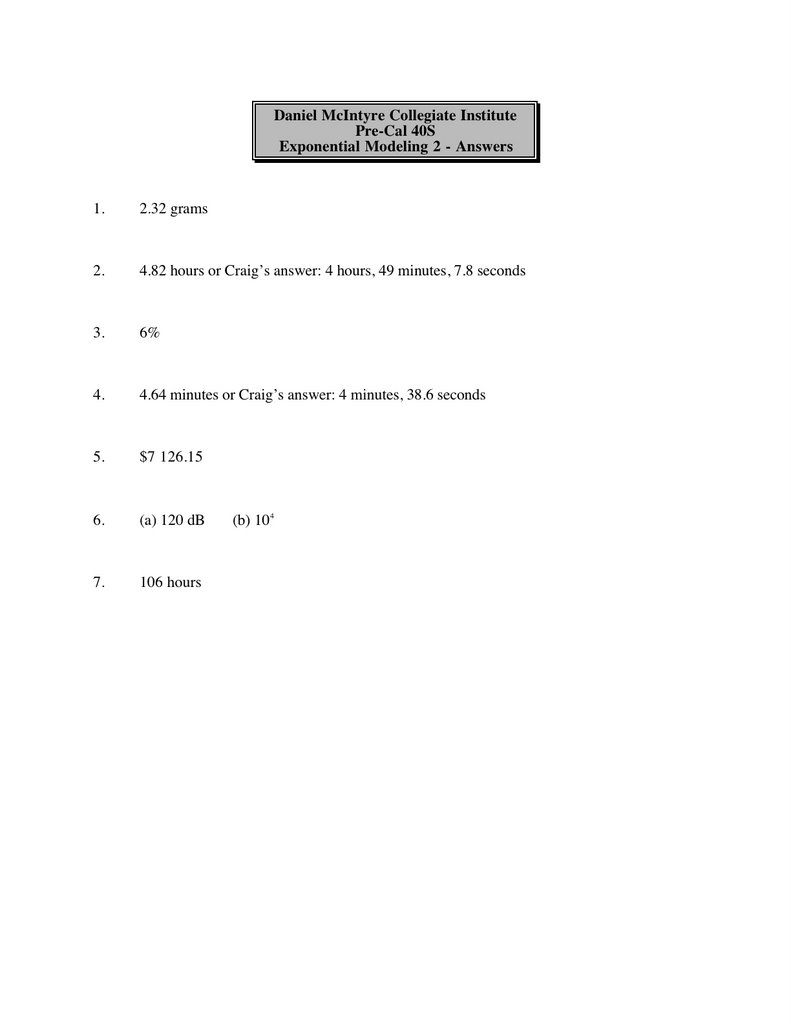
2)The population of a colony of Pre-Cal 40S math students grew from 3(10^5) to 4(10^5) during the period from noon to 2pm. (These guys really love math!) At what time will the population be 6(10^5)?
Po=5(10^5)
P=4(10^5)
t=2
When P=6(10^5), t=?
4(10^5)= 3(10^5)(model)^2 the (10^5)'s cancel out, and the 3 is taken out from the right side while the left side is multiplied by (1/3)
(4/3)^(1/2)=((model)^2)^(1/2) (to get rid of the "square" we give both sides a multiple of (1/2))
ln(4/3)=2ln(model)
(1/2)ln(4/3)=ln(model)
e^k= model (let k = that beast we call (1/2)ln(4/3))
6(10^5) = 3(10^5)e^(kt)
2=e^(kt)
ln2=kt
ln2/k=t
t=4.8188
The time would be 4 o'clock and 0.8188 hours (Im kind of clueless right now how to convert that to minutes >_> oh shame to me.)

Here, Mr.K just threw some exponential problems and showed how in different situations exponents might pop up in nasty places can be solved.

3^(2x-1)+1=2
3^(2x-1)=1 (bring the 1 over)
3^(2x-1)=3^0 (that is whats awesome about the number 1, it can be any base you want to the power of zero! That's great! Its like a candy store, with all these candies and the best of all, they're all candy...? No...? Never mind.)
2x-1=0 (both having the same base the exponents have a little party of their own in the form of an equation!)
2x=1
x=(1/2)

5./([4^3]-2)/[8^(x+1)]) = 16
([(2^2)(3x-2)]/(2^3)(x+1))^(1/5) = 2^4
((2^(6x-4))/2^(3x+3)^(1/5) = 2^4
(2x^(3x-7))^(1/5) = 2^4
2^(3x-7) = 2^20
3x-7 = 20
3x = 27
x = 9
Well, that's about it for the questions. Then Mr.K had popped up the questions: "Who here owns a suit?" And well, a few raised their hands. Then he said: "Well, what if I had 2 pants and 3 shirts. How many combinations of outfits can I get from that?
Introducing: Combinations and Permutations. A.K.A Counting.
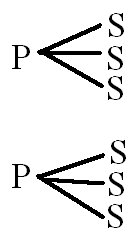
Now back to the million dollar question: How many combinations could there be? Well given this picture we break up the combinations into visual "paths."


You see we give each 'P' their own 'trees' because, well... you can't wear two pants at once! And then what branches out are the three shirts.

Simply, u can see hear, counting up all the little roots on the right hand side there are 6 possible combinations.

Well, great. 6 combinations. Now what if we wanted to....Ok, we'll add two ties to the bunch. How many combinations could there be? Well we'll jsut have to draw out the trees again, this time. Including the ties.


It gets big easily. So, now that we've added the ties, u can see there are 12 combinations possible.

Easy huh? Well after that, Mr.K decided to grab 4 students out of their chairs and stand infront of the class. He then explained how many combinations would there be for 4 students to sit in 4 chairs? Given that once one student had sat down, there would only be three combinations left. And so forth. Then he explained how to calculate this easily he wrote simply this on the board: 4!

No, not 4! as in I REALLY ment it. But 4! as in 4*3*2*1.

So what if it was 5!, then it would be 5*4*3*2*1, remember that it stops at 1, because if it reaches 0 it all becomes 0, and if its a negitive number, well it wouldn't make sense.

Variably it would be: n!=n(n-1)(n-2)(n-3)....3(2)1

Well if you've reached this far, you'll see a light at the end of the tunnel. This concludes the behemoth of a scribe post! Because Mr.K had been called down... to take a picture o_o;; Well, that and my fingers are getting really sore from typing all this. Ooh ooh, speaking about pictures being taken. After all that reading, enjoy this short, even thought it's about mother's day I still think it makes sense for this umm, current rambling. Enjoy, ScubaSteve out~!


November 13, 2006

Exponential Modeling


As promised here are links to some exponential modeling review sheets ...

Here are the questions and the answers to the handout I gave you last week.

Here is a new set of questions and answers for your review as you get ready for the test tomorrow. Some of the questions in this handout (like the flibberdejibbets question) are more difficult than anything you'll have to do on the test or January exam ... if you can so these you can do anything! ;-)

Learn Hard!

Cool picture ... what do you think it has to do with logarithms?

November 08, 2006

Scribe, Problem solving


In morning's class we talked about the equation , how it can't be zero:


Mr.K explain why it can't be zero. Well 00 doesn't not exist. That being zero can

never happen Because it can never touch the x-axis.Also it's undefined.


continuing from last Math dictionary


Example: Gerald invested $600 at 8% interest, compound semi-annually

How long will it take for his investment to double?


Solution:
A=P(1+c/n)cn

A: 1200
P:600
r:0.08
n:2
t:???


1200 = 600(1+0.08/2)2t

2=(1.04)2t
ln2 = 2t ln(1.04)
ln2/ln(1.04) =2t
(1/2 )ln2/ln(1.04) =t
8.8365 year = t


it would take 8 years or 10 months


How we got 10 month is:

8.8365 x 12 =10.0379


Common logarithm

The base 10 is used so frequently with logarithms that it is known as the "common logarithm".
when the base of a logarithm is not indicated , base 10 is assumed.


i.e. log10x = logx


Natural logarithm

e = 2.718281828459
e(Euler's number) is a number that a rises naturally in the logarithmic functions;
Partcularly in the case of coutinuous expontential growth ( or Decay)
The natural Log arithm is typicallu written as lnx;read as "Ellen of x"

ie logex = lnx


Exponential modeling

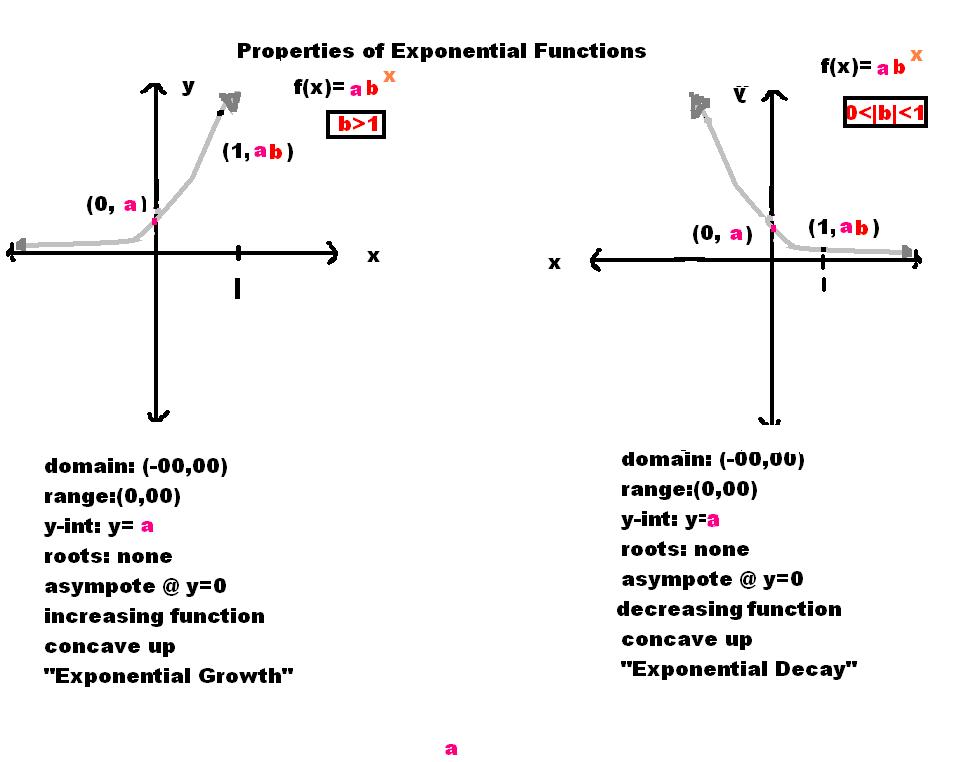
The basic function: f(x) =abx
how we model real life situations depends on what kind, or how much , information we are given:


case 1:

Working with a minimal amount of information(A,Ao, (Tri)t) we will create a model in base 10 and base e... base e is prefered.

A= Ao(model)*

A0: is the original amount of "substance" at the beginning of the time period.
A: is the amount of "substance" as the end of the time period.
Model: is our model for the growth (or decay) of the substance", it is usually an exponential expression in base 10 or base e although any base can be used.
t: is the amount of time that has passed for the substance" to grow(or Decay) from A0 to A.


example:

The population of the earth was 5 billion in 1990. In zool it was 6.2 billion.
a. model the poplution growth using an exponential function.
b.What was the population in 1999?

a.
A:6.2
A0: 5
(tri)t= t= 2001 -1990= 11


A=A0(model)t
6.2 = 5(model)11
The are two ways , but the same answer.

Base 10

Log(6.2/5) = log(model)11

log(6.2/5)= 11 log(model)
(1/11)log(6.2/5)=log(model)
0.00849 = log(model)
100.00849 = model

A=5(100.00849)
A= 1.0197

Base e

ln(6.2/5)= ln(model)11

ln(6.2/5) = 11 ln(model)
(1/11) ln (6.2/5) = ln(model)
0.01956 = ln(model)
e0.01956 = (model)
A= 5e0.01956t
e= 1.0197

b.
t = 9 in 1990 - 1999
a(9)= 5(100.00849(9))
=5.9622

A(9)= 5e0.01956(9)
=5.9622


Case 2: Given lots of information (A0,M,P)

A=Aom(t/p)

A: is the amount of "substance " At the end of the time period
A0: is the original amount of "substance" at the beginning of the time period.
M: is the "multiplication factor"or growth rate.
P: is the period; the amount of time required to multiply by "m"once.
t: is the time that has passed.


Example:

A colong of bateria double 6 days. If there were 3000 bacteria to begin with how many bacteria will there be in 15 days?

A=
A0=3000
M=2
P=6
t=15

A=Aomt/p
A=3000(2)15/6
A=16970.5628
There will be approximately 16971 Bacteria


At the end of the period there were three questions.


1. You have $10,000 and invest it all at 12% compounded quarterly
how long will it take you to become a millionaire?.


2. It is estimated that 20% of a radioactive substance decays in 30 hours
what is the half life of this substance?.


3.The population of toronto was 4000,000 in 2000. The growth is modeled by P(t) = 4000,000 e0.012t what year will the population be 6,400,000?.


.OOOO SNAP!!!!! XD
.
.

Next scriber is daphne


November 06, 2006

scribe, logs and exponents.

I'm the scribe today, so let's start (:

For the morning period - Mr. K was handing back all our quizzes, pre-tests, tests and so forths back to us. And he told us our mark currently in precal. Mr. K said that the number doesn't prove to anyone that it's how smart you are at math. The mark represents how much time and effort you put into this course. Yes, and then we started going over the tests which we had questions about..

For the afternoon class - Mr. K put questions on the board for us to do, and here they are:
Find the: A.) root     B.) inverse function
i.) y=8x-2     ii.) y+1=log8(x-2)

i.) y=8x-2
A.) no roots, because it doesn't hit/cross the x-axis.
B.) x=8y-2 ; switch the x and the y variable.
logx=log8(y-2) ; log both sides.
logx=(y-2)log8 ; bring down the (y-2)
logx/log8=y-2 ; divide both sides by log8
logx/log8+2=y ; bring the 2 to the left side, which becomes positive.
log8x+2=y
As you noticed, in the original question, it was minus two and for the inverse, it became positive two.

ii.) y+1=log8(x-2)
A.) 1=log3(x-2) ; y = 0
31=x-2 ; change to exponential.
5=x
B.) x+1=log3(y-2) ; switch the x and the y variable.
3(x+1)=y-2 ; change to exponential.
3(x+1)+2=y
Same for this one, in the original question, it was a minus two and for the inverse you get a positive two.

don't forget.. LOGARITHM IS AN EXPONENT!!

Solve for x: A.) log5(2x-1)+log5(x-2)=1
B.) log2(2-2x)+log2(1-x)=5     C.) 2x=7

A.) log5(2x-1)+log5(x-2)=1
log5(2x-1)(x-2)=1
(2x-1)(x-2)=51
2x2-5x+2=5
2x2-5x-3=0
(2x+1)(x-3)=0
2x+1=0     x-3=0
x=-1/2      x=3
You have to plug the numbers into the original equation to find out which one you can reject. So, if you plug in -1/2 into the equation.. (2(-1/2)-1), you would get -2 and (-1/2-2), you would get -2 1/2. SO that means it won't work, so it gets rejected. And if you plug in 3 into the equation.. (2(3)-1), you would get 5 and (3-2), you would get one. WHICH means, it will work (:

B.) log2(2-2x)+log2(1-x)=5
log2(2-2x)(1-x)=5
(2-2x)(1-x)=25
2-4x+2x2=32
2x2-4x-30=0
(2x+6)(x-5)=0
2x+6=0     x-5=0
x=-3          x=5
Same for this one, plug in -3 into the equation.. (2-2(-3)), which you would get eight and (1-(-3)), which you would get four. SO that means, it will work. And if you plug in 5 into the equation.. (2-2(5)), which would equal to -8 and (1-5), which would equal to -4. WHICH mean, it doesn't work out, so it gets rejected.

REMEMBER to CHECK before you REJECT (:

C.) 2x=7 ; log both sides.
log2x=log7 ; bring down the x variable.
xlog2=log7 ; divide by log2 so you could isolate x
x=log7/log2
log27=x

Then Mr. K talked about the compound interest formula.
Which is A=P(1+r/n)nt.
OH YEAH, A= accumulated amount of money
P= principal amount of money
r= rate in decimal form (interest rate)
n= number of compounding periods in a year
t= time in years
Mr. K then said he'll offer us a deal, if we invest one dollar and get 100% interest.
(1+(1/1))1=2
(1+(1/2))2=2.25
(1+(1/100))100=2.704813829

(1+(1/1000000))1000000=2.718280469

(1+(1/1000000000))1000000000=2.718281827
And so on, and so on..
The offer may sound good, but once you calculate it all out, it's really not alot. SO Mr. K talked about " e " (Euler's number), which equals to 2.718281828149
" e " can be written as an exponent as well. Which would be y=ex and as a log. Which is logex=y ..but we don't write it that way. SO it's written like this.. lnx=y which is a natural log of x.

Yeah, that's about it.. Um, the scribe for tomorrow is.. tennyson.

gooday&goodnight.

November 02, 2006

ScribeBadge11Ok guys, I guess I’m your scribe today, so lets get to it shall we….


When we first got to class, Mr. K began talking about
how important it is for us
to be doing our homework
during this unit. He says that this is the TOUGHEST

unit, and that he’s been trying to give us various
tools to help us through, but
if were not doing the
homework we’re not getting what we need. Mr. K really

wants us all to give the effort to do our homework because
he doesn’t want to
see anyone fail, so lets pull
up our socks and do our best to catch up.


Next Mr. k gave us a quiz, in which we were allotted 12
minutes to finish six
questions.

The questions were:

1. Find log 10(0.001)

log 10 1/ 1000 log 10 (1 / 10^3) log 10 10^-3 -3

2. Find log 2(64) + log 3(9)

log
22^6 + log 33^2
6 + 2
8

3. If 3^ X = 7, which is true?

a) 7 = log X (3) b) x= log 7 (3) c) 3 = log x (7)

d) 7 = log 3 (x) e) x = log 3 (7) f) 3= log 7 (x)

Answer: E

* A LOGARITHM IS AN EXPONENT*

4. If log a(25)= 4, what is a?

a) 1/ 5 b)√5 c)5 d) log 2 5 e)none of these

Answer: B

log a25 = 4

a^4 = 25

(a^4) ^ 1/4 = 25 ^1/4


a= √5

5. Find the log 100(1000000)

log 100(100^3) 3

6. Find log 100(10)

log
10010 log 100(100)^ 1/2 1/2


After the time was up Mr. K put all of these answers
on the board and asked
students which ones everyone
wanted explained.


When he was finished explaining, he began telling us
about how math is hard, and
that this course is one/or
the most difficult class in our high school career.
He
believes that most of the students have the attitude

“I just need to get by”
or “I just need to get this answer”
just like the players who throw the ball and it skims
the rim and goes in, we just need to get that basket
(answer). Our
attitudes are hurting us as just getting
the answer is not developing our
skills for seeing
things from many angles. If we were to learn things so
that we
can see the answer, or know the tools we need to
find the answer from many different
angles, this unit
would be easier, and we would know the answers instead
of getting
lucky.

Mr. K also told us that he wasn’t giving us a quiz to
punish us for not doing
our homework, but that he knows
that students who do there homework and have
quizzes to
make sure they are on the right track, do better in
the end.
Basically
“NOT DOING YOUR HOMEWORK HURTS”

It is easy to give us marks on things like scribe posts
andassignments where
people post comments, because their
learning is evident. But when students don’t
do their
homework and then do poorly on quizzes, their learning
isn’t evident,
and results are low marks.

The mark that you receive is not a measure of how smart
you are,instead it is
a measure of three aspects:

-Your time

-Your energy

-Your effort

If you do not put in these three aspects when doing
homework,class discussions,
or tests/quizzes then you
will never get up to your full potential, and your

mark will reflect it.


If you want a good mark
PUT THE TIME, ENERGY, AND EFFORT IN!!

Mr. K then moved on to explain that what we are doing
now are simply the
mechanics of logarithms. We are
learning the manipulations, and basics so that
we master
them before going on to the more difficult and
“interesting” problem
solving section of the unit
(starts Monday).Your basic skills must be
STRONG,because
there is no time to waste on worrying if your mechanics
are wrong when
you are doing a problem solving question.

Next Mr. K put these questions up on the board

*Don’t look at the answers before you’ve tried them yourself*


Write as a Single Logarithm


1. log a2 + log a3 2. log b4 + log b5 – log b2

3. ½(log cX + log cY)

Expand

1. log 2(MN) 2. log 2 M/N

Solve

1. log aX = 2log a3 + log a5

2. log cX – log c(X-5) = log c6

3. log aX = 3/2 log a9 + log a2

Answers:

Write as a Single Logarithm

1. log a2 + log a3
log a(2x3)
log a 6

2. log b4 + log b5 – log b2

log b (4x5)/2
log b 10

3. ½(log cX + log cY)

logc √XY


Expand


1. log 2(MN)

3 (log 2 MN)

3 log 2 M + 3 log 2 N

2. log 2 √M/(N^3)

1/2 log 2M + 3/2 log 2N


Solve

1. log aX = 2log a3 + log a5

log aX = log a3² + log a5

log aX = log a9 + log a 5

log aX = log a(9x5)

log aX = log a45

2. log cX – log c(X-5) = log c6

log c(X / X- 5) = log c6

X = 6X - 30

-5X = -30

X = 6


3. log aX = 3/2 log a9 + log a2

log aX = log a9∧3/2 + log a2

log aX = log
a27 + log a2

log aX = log a54

At the end of our first class Mr. K put these questions
on the board, told us to do what we could, and gave
us a couple minutes before the bell to finish them.

log 3(X+2) + log 36 = 3 log 6(X+1) + log 6X = 1


2 log 3X - log 3(X- 2) = 2

For the answers to these questions scroll down :D


After lunch.... it was Quiz time:
Ok guys... clear your desks, you can have a pencil,
you canhave an eraser, you can have a lucky charm,
their magically delicious, you can even have a lucky
rabbits foot, but not a real rabbits foot cause that's cruel.

*Here are the questions, try to answer them before you look at the answers below*

1) if log 102 ≈ 0.301, which of these is the closest to log 10(2000)?

a) 0.6 b) 3 c) 6 d) 30 e) 60 f) 300

2) if log 10 2 ≈ 0.301, which of these is closest to log 10 (8)?

a) 0.3 b) 0.6 c) 0.9 d)1.2 e) 2.4

3) if log 102 ≈ 0.301, which of these is closest to log 2(10)?

a) 0.5 b)1 c) 3 d)5 e) 20 f) 50

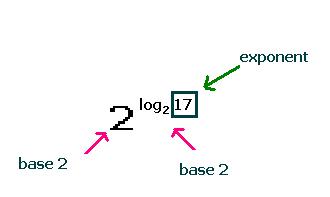
4) Find 2∧ log 2 (17)

5) Find 4 ∧ log 2 (3)

6) if log3 (10)= K, then log 9(10) =?

Twelve minutes up... time to take up the quiz...

Quiz Answers:

1) b--> 3

log 10(200)
log 10(2x1000)
log 102 + log 101000
0.301 + 3
3.301
3 is closest to 3.301

2) c--> 0.9

log 108
log 102∧3
3 log 102
3 (0.301)
0.903

3) c--> 3

Reason it out...

2∧3= 8 --> is the closest to 10...
the exponent for this
is 3... therefore the answer is 3

2∧4= 16

or

log 102 = 0.301 log 210 = X

10 ∧ 0.301 =2 2∧X = 10


(2∧x) ∧ 0.301 = 2∧1


0.301X = 1


X = 1
/ 0.301

4) 17


if x =17 is the answer of log2 X = 17

notice that the large 2 is also a base 2,
therefore the answer is 17


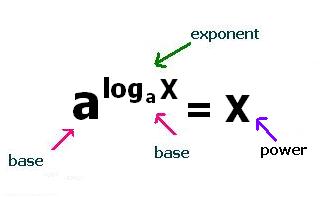
*SIDE BAR*

*A LOGARITHM IS AN EXPONENT*

2∧3 = 8
log 2 8 =3
could be written as:
2∧log 2 8 = 3

Back on track..

5) 9


4 ∧log 23
2
² ∧log 23

2 ∧ log
23²

2
∧ log 29

9

6. k /2

log 210 = k find log a10 = X

3∧k= 10 9∧X = 10

3∧k = 9∧ X

3∧k = 3∧2X

K= 2X

K
/ 2 =X


And that's it for the quiz folks... don't feel bad if you didn't
do well, the majority of the class seemed to be having
trouble... but if you did do well give yourself a pat on
the back....

After the quiz and the take up, Mr. K asked the class
some questions...

Who learned something?

- the majority of the class raised their hands

Who would have done better if they had done there
homework?

- a handful of honest students raised their hands

Next Mr. K asked us to finish the questions that were on
the board before lunch...

remember these from above??
log 3(X+2) + log 36 = 3  

log
3∧
[ (x+2) x6] = 3
(x+2)6 = 3∧3


6X + 12 = 27

6X = 15


log 6(X+1) + log 6X = 1

log 6 [ (X=1)x X] = 1 In this case there

X² + X = 6
is no exponent of

X² + X - 6 = 0
6 can give an output

(X+3) (X- 2) = 0
of -2, therefore

X= - 3
X = 2
NO NEG. #'s CAN

Reject X= -3
BE USED


We reject negative numbers because

*ALL IMPUTS MUST BE POSITIVE*

2 log 3X - log 3(X- 2) = 2

log3X² - log 3(x- 2) = 2

log
3 [X² / (X-2)] = 2

(x-2) x [ X² / (X-2)] =2


X² = 9 - 18


X² - 9X + 18 = 0


(X- 3) (X- 6) = 0


X = 3 X= 6


BOTH ARE POSITIVE, THEREFORE BOTH ARE THE ANSWERS


After we finished taking up the questions, Mr. K
started talking about our homework from last night
(making a del.icio.us account,and finding 4 sites
1 for each unit we have studied. After a brief
talk,we began another round of questioning:

Do we think that del.icio.us is a useful tool?
-yes

Do you think it would be more beneficial if students took 15-20
mins to find a site that actually
helped them understand
concepts rather than just picking the first site they find so they
can receive marks?

-yes

If you take the time to find one helpful site, and your class mates
take the time to find helpful sites then for your imput of 1 site you
get 22 in return. Is this beneficial to you?

-yes

We kind of got the point across that getting help is more important, then marks
so when he asked the question

Who thinks that you should be marked on your contribution to del.icio.us ?

-no one raised their hands

Ok guys time to step it up a notch...

Mr. K then put much more challenging equations on the board and asked
us to solve them:

1. log b (X-1) + log b (X+2) = log b (8 - 2X)

log b [(X- 1) (X+2 )] = log b (8 - 2X)


X² + X -2 = 8 - 2X


X² + 3X - 10 = 0


(X + 5) (X- 2) = 0


X= -5
X= 2

REJECT NEGATIVES

2.log 10 (X+ 6) + log 10 (X-6) = 2

log (X² -36) = 2

X² - 36 = 100

X² - 136 = 0

X = √136


2^X = 7 5^X = 11 Find X

log 2X = log 7

X log 2 = log 7


X = log 7 / log 2

*NO BASE WRITTEN MEANS THE EQUATION IS USING BASE 10*


After taking up these questions, Mr. K started the final topic of
the day....


Base Values


We use the base value 10

therefore we have 10 base numbers

0, 1, 2, 3, 4, 5, 6, 7, 8, 9

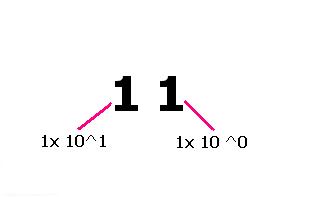
The number ten is represented by 10.... as the first numbers all begin with zero, the next set of ten will begin with one, and so on.

11, 12, 13, 14 etc.

the pattern continues as you move forward, the next set will begin with twos

20, 21, 22, 23 etc.

this pattern continues all the way through our number system.

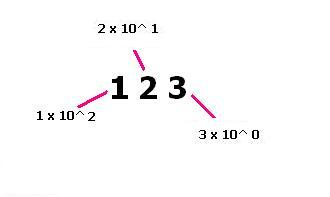
Another way to look at this is :

This uses 10 as the base number and grows from there

another example of this is
1 x 10^2 = 100
2 x 10^1 = 20
3 x 10^0 = 3

100 + 20 + 3 = 123

But if we were to use a base of 6 instead for example, we would only have 6 numbers

0, 1, 2, 3, 4, 5

6 would be represented as 10

and 7 would be represented by 11, following the pattern:
Therefore using the base number 6, the number we know as 123 in base ten would actually equal 51 in base 6,
1 x 6^2 = 36
2 x 6^1 = 12
3 x 6^0 = 3

36 + 12 + 3 = 51

That's where class ended today folks... i know its a lot, but ALL of it was important.... I hope
this post was helpful for you!! Good luck guys!!

Ok well i guess the next scribe will be....

*ALLEN*

Best of Luck


October 31, 2006

Exponentials & Logarithms --a trick for students; a treat for teachers

ScribeBadge11


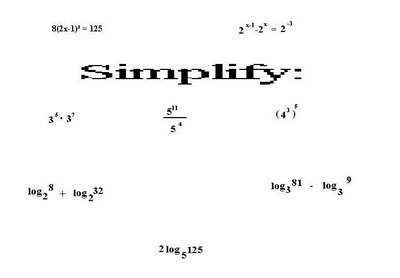
At the beggining of class we were given 9 questions to solve they were seen on the whiteboard like this


We were given time to solve this equations, after the time was done we explained how we got our answers.


Question #1


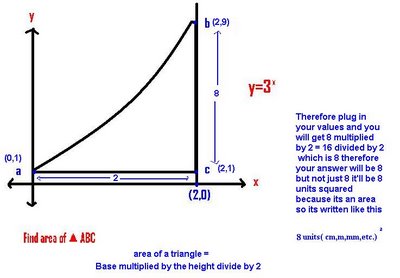
To find the area of triangle ABC we had to find the points of A, B ,C is this is the step by step solution.


Point A is found by plugging our x value into the equation y=3x, our given value for x was zero(0), and any power to the exponent of 0 will always equal to 1, which gives us the coordinates (0,1) and that is the coordinate for point A


Point B is found by plugging in our x value also into the equation, we got the value of x by the ordered pair below point B which was (2,0), when we plug in the value of x into the equation y=9, so the coordinates of point B would be (2,9)


Point C is found because we are given the x value which is also seen by above in Point B, and the point Below it, because there on the same x distance, but just different y distance,so the x value is 2, and the y distance is going to be the same as point A because it lies on the same height as point A, so the y value is 1, so the coordinates of Point C is (2,1)


So the solution for question #1 is 8 units squared


Question #2


the solution to question # 2 is found by finding the value of base of x, we simplified it into becoming 2³(2x-1)³=5³, it had the same exponents so we dropped them and simplified it to [2 (2x-1)] ³ = 5³, then we simplified it by it equaling 4x-2 =5, we then moved the -2 onto the other side od the equal sign and we get 4x=7, we then isolate the x and get x= 7/4


So the solution to question # 2 is x=7/4


Question #3


It was a homework question for two classes ago. First off we went by re-writing the question into making it look like this 2^x/ 2 - 2^ x= 2^-3, to make the fraction disappear in the equation we multiply by 2 on both sides of the equal sign, therefore the equation will now look liek this 2^x - (2)2^x=(2)2^-3, at this point dont add because you'll end up getting the original equation, so what you do now is solve by factoring. You will isolate the varaible 2^x. So it will be written like this 2^x(1-2)=2^-2, it will then end up like -2^x = 2^-2 , after simplifying. Therefore we concluded there is no solution because even if you were to multiply everything by 1 youll still have a postive power one side, and a negative power on the other, therefore staing its not true.


So the solution for question # 3 is NO SOLUTION


Question #4


When we were asked to simplify (3^ 5)(3^7), we can say that when we are multiplying powers with the same base we add the exponents, therefore it can be simplified by writing it like this 3^(5 +7), in other words 3^12


So the solution for Question # 4 is 3^12.


Question # 5


when we are asked to simplify 5^11/5^4 we can say that when dividing powers with the same base we subtract exponents. If you apply this concept you will get an outcome like this 5^(11-4) or in other words 5^ 7.


So the solution for question #5 is 5^7


Question # 6


When we are asked to simplify (4^3)^5, we can say that when a power is raised to a power we multiply the exponents, so it would look like this [4^(3)(5)] or in other words 4^ 15


So the solution to Question#6 is 4^15


Question 7-9 remember LOGARITHMS ARE EXPONENTS!! BECAUSE MR.K KNOWS THAT AT LEAST 6 OF US ARE GOING TO FORGET. These questions are also for us to adapt on knowing how to run our tools backwards, and fowards.


Question#7


When asked to simplify log2^8 + log2^32, we look at as its adding expoents, so your multiplying powers that have the same bases, so that question can be simplified as log2^(8)(32) or log2^256.


So the solution for Question #7 is Log 2^256


Question #8


When asked to simplify log3^81 - log3^9, we look at it as we are subtracting exponents meaning we are diving powers. Thefore the equation can be written like log3^(81/9) or in other words log3^9.


So the solution for Question # 8 is log 3^9


Question #9


When asked to simplify 2log5^125, we see here that we are going to multiply powers, which can be also known as to raising a power to a power. So it can be written like log5^125^2,or in other words log 5^15625


So the solution for question #9 is log 5^15625.


log a^(mn) = log a ^m + log a^n


log a ^(m/n)= log a ^m - log a^ n


log a^(m^c) = C loga^m


The above was written on the whiteboard after the qesutions were completed. These are the concepts we applied to our questions from earlier to get our solutions.


We were then given some new questions, and we were asked to write them as a single logarithm


The four questions were


a) 1/2 log a^9 - log a^3


simplify the equation as log a^3 - log a^3 which will give us loga ^ 3/3 by the corresponding concept of subtracting exponents meaning your dividing powers, you will then get to simplify as loga^1 which will give us 0.


The solution to a) is zero(0)


b)log a^6 + log a^4


adding exponents is the same as multiplying powers, so therefore it would simplify as loga^(6)(4), which in other words can be loga^24.


The solution to b) is loga^24


c) 2log a^5 + loga^4


simplified as loga^25 + loga^4, then we apply the adding exponents meaning multiplying powers so we simplify it by writing it as log a^ 100.


The solution to c) is loga^100


d) log a^ 6 + log a^ 8 - 1/2log a^16


therefore we simplify the adding of exponents as multiplying powers, and then simplifying the multiplying of exponents as power raised to a power, so it can be rewritten like,loga^(48)-log a^(16^1/2), which then can be simplified as loga^ (48/4), which can even be more simplified as loga^12.


The solution to d) is log a^12


GET OUT YOUR MATH DICTONARIES


NEW PAGE EVERYBODY


Logarithms


Definition:


#1 the logarithm function is the inverse of the exponental function.


#2 the logarithm function is the function that turns powers into exponents.


REMEMBER: A LOGARITHM IS AN EXPONENT!


And thats all for today folks.....and the next scribe is Richard..he knows already =)

October 30, 2006

Jefferson's scribe post - brief intro to logs

We were given questions as usual:


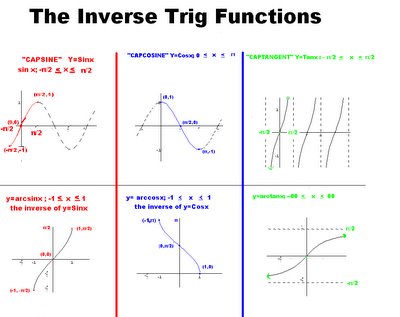
Sketch:

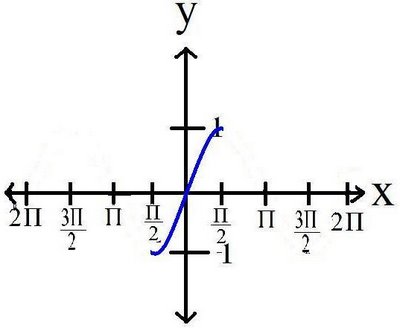
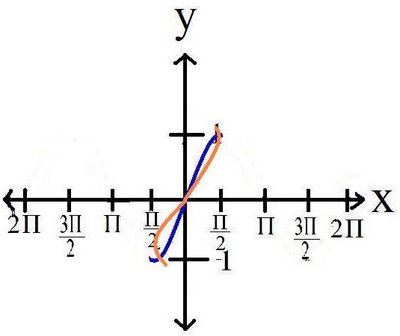
a) f(x) = sinx on the interval [-pi/2, pi/2]
*sketch a normal sine function to start.
since there was a domain given erase the graph so that the sine function is between -[pi/2 and pi/2]

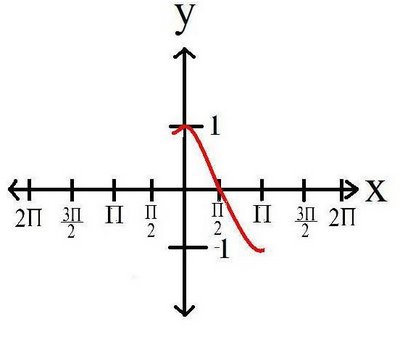
a) g(x) = cosx on the interval [0, pi]


*pretty much the same as the top

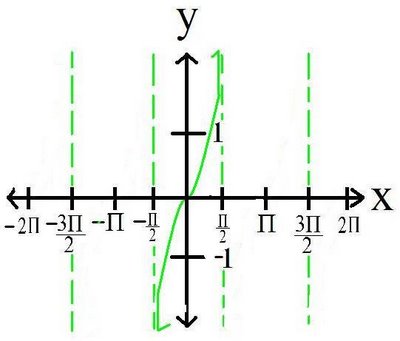
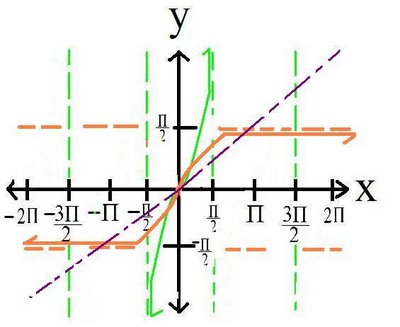
c)h(x) = tanx on the interval [-pi/2, pi/2]


*and again the same steps apply here


next we were asked to sketch the inverse of the three graphs

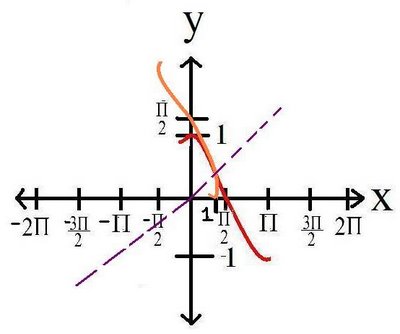
a)

*draw the line of reflection y=x.
the coordinates change from (x,y) to (y,x) ei (2,3) to (3,2)
the original graph is just flipped over the line of reflection


b)


*same rules apply

c) *this one may be a little tricky
draw the line of reflection to start out with
since the graph is being reflected, so are the asymptotes
the asymptotes are now at x = 0 (orange)

Next we were asked to sketch:

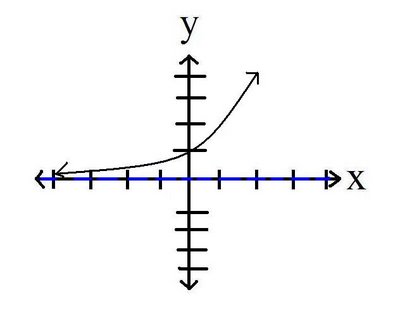
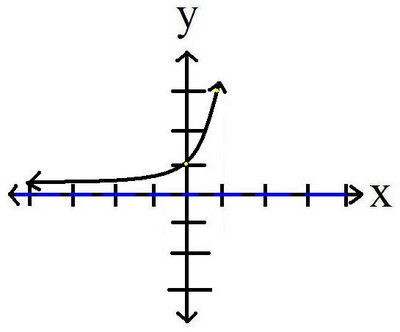
y = 2^x

*the two most easy points you can get are when you input 0 and 1. If you replace x with 0 as an input you get an output (y coord) as 1. if you replace x with 1 as an input, then you get an output of 2


y = 3^x
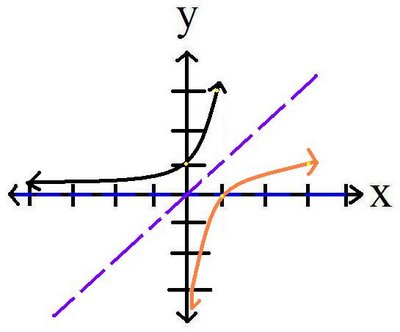
next we had to sketch the inverse of the two :
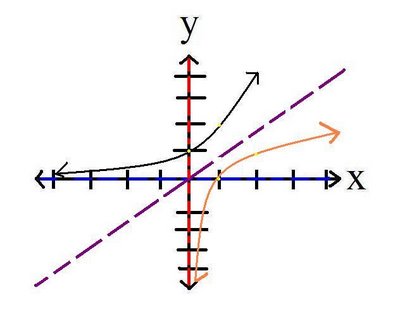
*draw the line of reflection first. since the graph is being flipped over the line y = x, the asymptote(blue) is also being flipped.
*the new asymptote is at y = 0 (seen in red)
*if you forget the order of pairs (x,y) are flipped to (y,x)

y = 1/(2^x)
y = 1/(3^x)


when you input a number you nonetheless gt an output of the result. the inputs of these graphs are the exponents(x). And from the input you get an output of a power. IE 2^2(input/exponent) = 4(output/power)

Now when you do the inverse, the input is the power and the output is the exponent. it's basically saying it backwards, that's pretty much what an inverse is...sorta.


NOW it is time for me to bring in the logarithm aka the LOG(no not the tree log) . a log is a number but not any number. its a number that is formed from a result. An example Will come up later on this scribe post.


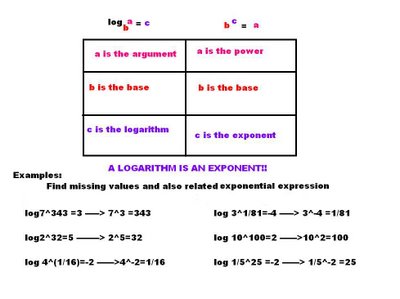
ba=c


b = base
a = exponent
c = power


this is the basic formula for powers and exponents

a logarithm reverses that equation:

logb(c) = a


this equation says that a logarithm is an EXPONENT!
you WILL i repeat WILL hear Mr k repeat this 100 times! because students will often forget about this

here's an example:

23 = 8
log2(8) = 3

*the 8 and 3 switch because a logarithm is an exponent.

heres another
53 = 125

log5125= 3


the next scribe will be.....jhoann